
Property Prices Are Falling. So Why Is Buying a Home Getting Harder in Australia?
Bharat Finance Editorial Team · Published 14 November 2026 · Updated 14 November 2026
Property Prices Are Falling. So Why Is Buying a Home Getting Harder in Australia?
The Australian Wealth Playbook | Edition 2 | 14 November 2026
Published: 14 November 2026 | By Piyush, Founder & Principal Mortgage Broker, Bharat Finance
Imagine waiting months for property prices to fall, only to discover that you can now borrow less than before.
Sounds frustrating, doesn’t it?
A property that was previously out of reach is suddenly $50,000 cheaper. You would expect your chances of buying it to have improved.
But what if your borrowing capacity has fallen by $100,000 during the same period?
Suddenly, that cheaper property may be even further out of reach.
This is one of the biggest contradictions emerging in Australia’s housing market in 2026.
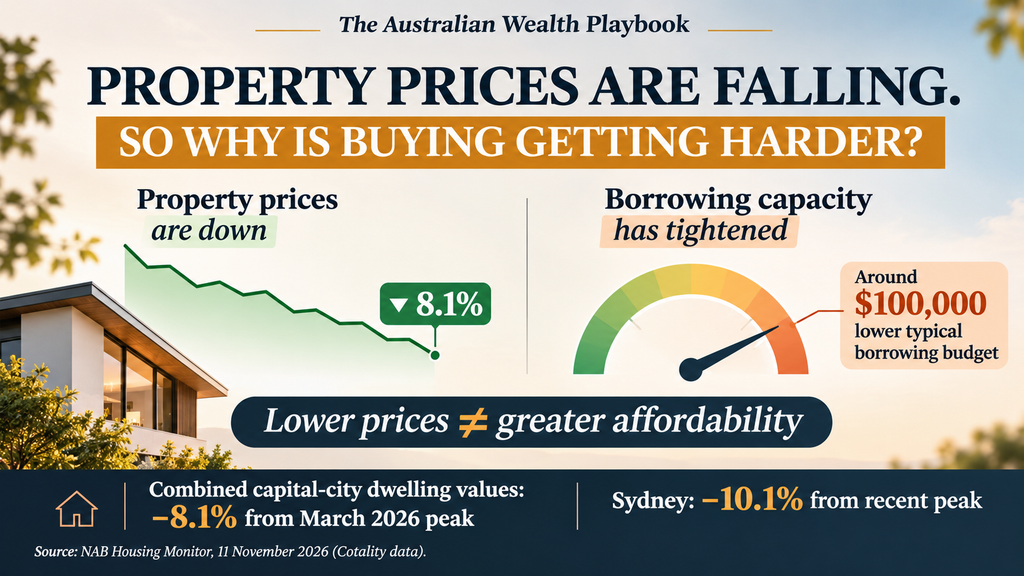
Property prices are falling, but higher interest rates are reducing borrowing capacity and making it harder for many Australians to buy.
And the latest numbers tell an interesting story.
Australian property prices are falling, but borrowing power is shrinking
According to NAB’s November 2026 Housing Monitor, combined capital-city dwelling values have declined 8.1% from their March 2026 peak.
The downturn is affecting several major markets:
| Capital city | Decline from recent peak |
|---|---|
| Sydney | 10.1% |
| Melbourne | 7.8% |
| Brisbane | More than 8% |
| Perth | More than 8% |
Source: NAB Housing Monitor, 11 November 2026.
Meanwhile, recent analysis from Lendi and Aussie Home Loans suggests that five interest-rate increases in 2026 have reduced a typical Australian homebuyer’s budget by approximately $100,000.
For a couple earning median wages with a 20% deposit, estimated borrowing power has fallen 10.6% since January.
Think about that for a moment.
Prices are declining, but the amount buyers can borrow is declining too.
A lower property price does not necessarily mean better housing affordability.
Why can falling prices make little difference to your ability to buy?
The answer comes down to how lenders assess borrowing capacity.
When applying for a mortgage, banks don’t simply check whether you can afford repayments at the advertised interest rate.
They also assess whether you could manage repayments if rates were higher.
APRA requires regulated banks to generally assess home loans using an interest-rate buffer of at least 3 percentage points above the applicable loan rate.
For example, a loan with an interest rate of 6.5% would generally be assessed at a minimum of 9.5%, subject to the lender’s broader serviceability methodology.
This is designed to reduce the risk of borrowers becoming financially overstretched.
But as interest rates increase, this assessment can significantly reduce the amount someone qualifies to borrow.
That means buyers can find themselves in an unusual situation.
The property they want is getting cheaper, but their ability to finance it is getting weaker.
Investors are pulling back. Is this creating opportunities?
Another significant development emerged from the Australian Bureau of Statistics on 11 November.
New investor housing loan commitments fell 30.6% by number during the September quarter, the largest quarterly decline recorded in the series.
Meanwhile, new owner-occupier first-home buyer commitments also declined, by 8.6%.
These are quarterly changes in new loan commitments, not declines in total outstanding mortgages.
The figures suggest that investors are becoming more cautious, but first-home buyers are not necessarily rushing in to replace them.
Higher interest rates, softer property values and uncertainty around future market conditions are influencing decisions.
The RBA has also acknowledged that property prices and new housing lending have declined more sharply than expected.
For some buyers, this environment may create opportunities.
But there is an important distinction between a property being cheaper and a property being a good purchase.
A discounted property with poor fundamentals, expensive holding costs or unsuitable financing can still be a costly mistake.
The overlooked risk for existing property owners
Falling property values don’t affect only people trying to buy.
They can also change the financial position of existing homeowners and property investors.
Consider a simple example.
You own an investment property valued at $1 million, with an outstanding loan of $700,000.
At an 80% loan-to-value ratio, the theoretical usable equity is $100,000.
Now imagine the property value falls by 10%.
The property is worth $900,000, while the loan remains at $700,000.
Your theoretical usable equity at 80% LVR has now fallen to just $20,000.
A 10% fall in property value has reduced your potentially usable equity by 80%.
And even that $20,000 may not be accessible if you cannot satisfy the lender’s borrowing-capacity requirements.
This is why understanding the difference between property equity and borrowing capacity is so important.
A property portfolio can have substantial equity on paper without providing the financial flexibility needed for the next purchase.
This example is illustrative. Actual accessible equity depends on valuations, lending policies, existing securities, borrowing capacity and applicable costs.
So, should buyers wait for property prices to fall further?
There isn’t one answer that works for everyone.
NAB currently forecasts a peak-to-trough decline of approximately 14% across the combined capital-city housing market, with a possible trough in the second quarter of 2027.
But forecasts can change.
And even if property prices decline further, borrowing costs, income, lender policies and personal circumstances may also change.
Rather than trying to predict the exact bottom of the market, I believe buyers should focus on three questions:
1. What can I comfortably afford today?
Not simply what a lender might approve, but what works after considering living expenses, savings and future commitments.
2. Is my financing structured appropriately?
Interest rates matter, but so do loan features, repayments, offsets, cash flow and longer-term borrowing objectives.
3. Will the property still make financial sense if market conditions remain difficult?
For investors in particular, the ability to manage holding costs and unexpected expenses is critical.
Sometimes the right decision is to buy.
Sometimes it’s to refinance, review existing loans, reduce debt or build additional cash reserves.
And sometimes waiting is the most sensible option.
My perspective: Financial readiness matters more than perfect market timing
Through my own property investing journey and my work in mortgage broking, one lesson continues to stand out.
Wealth creation isn’t just about finding the right property. It’s about being financially positioned to make the right decisions and hold your investments through changing market conditions.
People spend a lot of time trying to predict what the RBA will do next or when property prices will reach their lowest point.
But far less attention is sometimes given to borrowing structures, cash flow, usable equity and the ability to manage financial risks.
Those are things we can review and improve.
A falling market doesn’t automatically create an opportunity.
It creates the possibility of an opportunity.
Whether that opportunity is right for you depends on your financial position, the quality of the property and the decisions you make.
The market will continue to change.
The question is whether your financial strategy is keeping up.
Has your borrowing capacity changed?
If you’re planning to purchase your first home, upgrade, refinance or expand your property portfolio, it’s worth understanding your current lending position before making another financial commitment.
At Bharat Finance, we look beyond simply securing a loan. Our approach focuses on reviewing borrowing capacity, loan structure, cash flow and financing options in the context of your objectives.
Request an obligation-free mortgage and borrowing-capacity review.
Bharat Finance | Guiding you. Building wealth.
Sources and references
- NAB Housing Monitor, 11 November 2026
- Australian Bureau of Statistics, Lending Indicators, September Quarter 2026
- Hotspotting, Borrowing Power Drops, 12 November 2026
- Reserve Bank of Australia, Statement on Monetary Policy, November 2026
- APRA, Mortgage Serviceability Buffer
Disclaimer: This article provides general information only and does not constitute personal financial, investment, tax or legal advice. Market forecasts and lending conditions may change. Loan eligibility and suitability depend on individual circumstances and lender requirements. Information is current as at 14 November 2026.