
RBA Interest Rates November 2026: What’s Next for Home Loans?
Bharat Finance Editorial Team · Published 4 November 2026 · Updated 4 November 2026
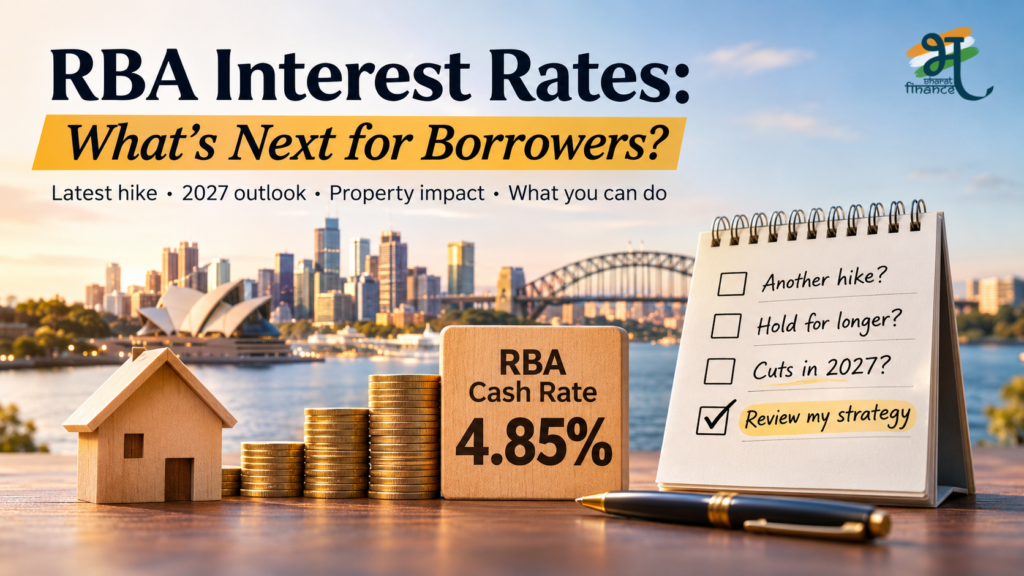
Interest Rates Are Rising Again. But Waiting for the RBA Could Be Your Most Expensive Mortgage Strategy.
Australia’s cash rate has reached 4.85%, its highest level since 2008. Are we finally approaching the peak, or is there more pain ahead for homeowners and property investors?
By Piyush | Principal Mortgage Broker, Bharat Finance
4 November 2026 | Australian Property & Mortgage Insights
For much of the past few years, Australians have been asking one question:
“When will interest rates start coming down?”
Just when borrowers thought relief might be around the corner, the conversation changed again.
On 3 November 2026, the Reserve Bank of Australia (RBA) increased the official cash rate by another 0.25 percentage points to 4.85%.
That’s the fifth increase this year, taking the cash rate to its highest level in 18 years.
For homeowners, it means further pressure on household budgets. For investors, it changes the cash-flow equation. And for first-home buyers, it raises another uncomfortable question: should they wait for rates to fall, or could waiting create a different set of challenges?
But I believe there is a more important question we should be asking.
Instead of trying to predict what the RBA will do next, are we doing enough to prepare our finances for whatever happens?
Let’s examine what’s happening, what economists expect, and how borrowers can approach their next financial decision.
Why are interest rates rising again?
The answer starts with inflation.
The RBA’s job is to maintain price stability while supporting employment and economic prosperity. Its inflation target is 2–3%.
Unfortunately, inflation has proved more persistent than previously expected.
The September-quarter inflation figures showed headline inflation running at 4.3% annually, with underlying inflation also remaining elevated.
Several factors are contributing:
- Higher energy prices: The conflict in the Middle East has pushed up global oil prices, increasing costs for transport, businesses and households.
- Persistent domestic price pressures: Rising costs are affecting a broad range of goods and services, not just petrol.
- Capacity constraints: Parts of the economy are still struggling to meet demand without further price increases.
- Strong business investment: Technology and data-centre investment are supporting economic activity, but may also add pressure to resources and costs.
These pressures have forced the RBA to revise its inflation outlook.
In its November forecasts, headline inflation is expected to reach approximately 4.5% by December 2026. Both headline and underlying inflation are expected to remain above 3% until late 2027.
In other words, inflation is proving harder to bring under control than anticipated.
And that makes the interest-rate outlook more complicated.
Have we reached the peak of interest rates?
Possibly. But nobody can confidently say so yet.
One of the most interesting aspects of the November decision was that the RBA board was divided.
Six members voted to increase rates, while three preferred to leave them unchanged.
The RBA also removed wording that had previously referred explicitly to further rate increases.
That is significant.
It suggests that some policymakers are increasingly concerned about how much pressure households and businesses can absorb.
But it does not mean the RBA has ruled out another increase.
What are the banks predicting?
The four major banks broadly expect the RBA to keep rates unchanged at its December meeting.
ANZ and NAB believe monetary policy is now highly restrictive and expect the cash rate to remain on hold in the near term.
Westpac also sees a December pause as likely, although it acknowledges that another increase remains possible.
Commonwealth Bank expects rates to remain unchanged in December and forecasts two reductions in late 2027, which would bring the cash rate to 4.35% if realised.
Judo Bank presents a more cautious outlook.
Its economists expect an extended period of unchanged rates, but believe the risks lean towards further increases during 2027 if inflation remains stubborn.
The important distinction is that these are economic forecasts, not promises.
The RBA will respond to incoming inflation, employment and economic growth data.
A change in those conditions can quickly change the outlook.
The other side of the story: Australia’s housing market is slowing
While the inflation outlook remains challenging, higher interest rates are already influencing property markets.
Judo Bank’s October 2026 Housing Pulse estimated that national dwelling prices had declined approximately 6.7% from their March peak.
Its analysis also identified substantial recent weakness in Brisbane and Perth, two markets that had previously enjoyed strong growth.
Judo expects national prices could stabilise around the first quarter of 2027, although its forecast suggests the total peak-to-trough decline could approach 10%.
That is one economist’s projection, and the timing and depth of any recovery remain uncertain.
Still, the implications are important.
Higher borrowing costs generally reduce the amount buyers can comfortably spend, while uncertainty can discourage property transactions.
For existing homeowners, declining property values can also reduce usable equity.
This creates an interesting situation.
Interest rates may eventually fall, but lower rates do not automatically mean stronger borrowing positions for everyone.
Income, expenses, existing debts, lender policies and property valuations all matter.
What do these rate rises actually cost borrowers?
According to estimates reported by the Mortgage & Finance Association of Australia (MFAA), the November increase alone could add approximately $119 per month to repayments on an average new owner-occupier loan of $731,000, assuming lenders pass on the full increase.
Across the five increases in 2026, the cumulative effect on this illustrative loan is approximately $537 per month.
That’s roughly $6,450 a year in additional repayments.
For a household already managing childcare, groceries, insurance and living expenses, this is not a minor adjustment.
For property investors managing multiple loans, the cumulative cash-flow impact can be substantially greater.
And this is where the discussion needs to move beyond simply watching interest rates.
The mistake borrowers can make: focusing only on the interest rate
One conversation I regularly encourage borrowers to have is about the structure of their finances.
The interest rate matters. Of course it does.
But it is not the only factor determining whether a loan is suitable, affordable or supporting your longer-term objectives.
Consider two borrowers with similar loan balances and interest rates.
One may have substantial funds sitting in an offset account, a manageable repayment structure and enough cash-flow flexibility to handle further increases.
The other may have multiple loans, limited liquidity, an expensive repayment structure and little room for unexpected expenses.
Their exposure to the same RBA decision can be very different.
That’s why I believe mortgage reviews should go beyond asking:
“Can I get a cheaper rate?”
They should also examine:
1. Cash-flow efficiency
Is your loan structured appropriately for your current financial circumstances?
Could a competitive rate, suitable offset account or carefully considered repayment arrangement improve your position?
2. Loan structure
Are owner-occupied and investment borrowings structured appropriately?
Could changes to repayment types, loan splits or facilities help achieve your objectives without creating unnecessary costs or tax complications?
3. Borrowing capacity
Has your borrowing capacity changed?
Higher assessment rates, living expenses and existing debt commitments can affect what lenders are willing to approve.
4. Equity and liquidity
How much usable equity do you actually have, and how much can you responsibly access?
Equity and borrowing capacity are not the same thing.
5. Long-term financial goals
Are your current lending arrangements supporting your next property purchase, your investment strategy or your plans to reduce debt?
A lower advertised interest rate is not necessarily the best outcome if the overall structure works against your objectives.
Should first-home buyers wait?
This is one of the hardest questions in today’s market.
There are reasonable arguments on both sides.
Waiting might allow buyers to build a larger deposit, reduce existing debt or observe how prices and rates develop.
Buying sooner might make sense for someone with stable income, sufficient savings and a suitable property available at a manageable price.
However, two assumptions can be dangerous:
“I’ll buy when interest rates fall.”
Rates may remain elevated longer than expected. And when they eventually fall, changing buyer confidence and borrowing capacity may alter market conditions.
“Property prices are falling, so this must be a buying opportunity.”
Falling prices do not automatically create good investments. Location, property quality, valuation, future supply and affordability remain essential.
The better question is whether the purchase works under realistic financial assumptions – including the possibility of higher repayments.
What should property investors be considering?
For investors, rate rises affect more than monthly repayments.
They influence rental cash flow, borrowing capacity, holding costs and the feasibility of acquiring additional properties.
Investors with several properties should consider reviewing their portfolio as a whole rather than examining each loan independently.
This may include:
- Understanding the cash-flow impact of another rate increase.
- Reviewing interest-only and principal-and-interest arrangements where appropriate.
- Assessing whether existing loan structures align with investment and tax objectives.
- Maintaining liquidity for vacancies, repairs and unexpected expenses.
- Reassessing future purchases using conservative repayment and rental assumptions.
Debt recycling, equity release and other restructuring strategies may be relevant in particular circumstances, but they are not universally suitable and require careful consideration of lending, legal and taxation consequences.
A well-structured portfolio should not depend entirely on interest rates falling.
What happens next? Three possible scenarios
Rather than pretending to know exactly what the RBA will do, I prefer to consider three possible paths.
Scenario 1: Rates remain unchanged for an extended period
Inflation gradually moderates, but not quickly enough to justify immediate reductions.
Borrowers continue dealing with elevated repayments while the RBA assesses the impact of previous increases.
This broadly reflects the near-term expectations of several major-bank economists.
Scenario 2: Another rate increase in 2027
Energy prices remain high, underlying inflation persists or other inflationary pressures prove stronger than expected.
The RBA may decide that further tightening is required.
This remains a genuine risk highlighted by economists including those at Judo Bank.
Scenario 3: Economic weakness eventually allows cuts
Higher interest rates slow economic activity more sharply than anticipated, unemployment rises and inflation eases.
The RBA may then have room to reduce rates.
Commonwealth Bank’s forecast for two cuts in late 2027 illustrates one possible version of this scenario.
None of these paths is guaranteed.
And that’s precisely why financial decisions should be tested against more than one possible outcome.
My perspective: Don’t wait for certainty that may never arrive
I often see people become so focused on predicting the next interest-rate decision that they overlook the things they can actually control.
We cannot control inflation, international oil prices or the RBA’s decisions.
But we can review how our finances are structured.
We can understand our debt, cash flow, available equity and borrowing capacity.
We can assess whether our current lending arrangements remain appropriate.
And we can make decisions based on informed analysis rather than headlines.
The objective isn’t to predict the market perfectly. It’s to build a financial position that can withstand the market being unpredictable.
At Bharat Finance, our approach is built around understanding the bigger picture – not just arranging a loan, but helping clients evaluate their lending structures, property portfolios and financial objectives.
Whether you are a homeowner reviewing your mortgage, a first-home buyer considering your next move or an investor managing multiple properties, now is a sensible time to understand where you stand.
Because sometimes the most valuable financial decision isn’t buying another property or refinancing immediately.
It’s understanding what your next move should be – and what it could cost if you get it wrong.
Bharat Finance | Guiding you. Building wealth.
Thinking about reviewing your current lending arrangements or property portfolio?
Visit https://bharatfinance.com.au/contact/ to discuss an obligation-free mortgage and lending review.
Important information: This article reflects publicly available information and economic forecasts as at 4 November 2026. Forecasts can change. Content is general information only and does not take account of individual objectives, financial circumstances or needs. Loan restructuring, investment and taxation decisions should be assessed with appropriately qualified professionals. Lending remains subject to individual circumstances and lender approval.
Sources and further reading
- Reserve Bank of Australia — November 2026 Monetary Policy Decision
- RBA — November 2026 Statement on Monetary Policy
- Broker Daily — Where Will Rates Go From Here?
- Broker Daily — RBA Spurred Into Action on Rate Day
- Judo Bank economic commentary, RBA Rate Update (November 2026), Weekly Briefing (2 November 2026) and Housing Pulse (October 2026).